 MCPProxy
CSAI Is Now Issuing CVEs for MCP Servers: What That Means for Your Admission Records
The Cloud Security Alliance announced on April 29, 2026 that its CSAI Foundation has been authorized as a CVE Numbering Authority. CNAs are the organizations empowered to assign formal CVE identifiers within their declared scope. There are now several hundred of them globally — operating systems vendors, cloud providers, vulnerability research firms, and the major open-source projects all run their own. CSAI is the first one whose declared scope is AI infrastructure specifically, and the first whose scope explicitly includes MCP servers as a covered class.
The announcement was short on dramatic language and long on specifics. The CSAI Foundation will issue CVEs for vulnerabilities in agentic AI systems, with MCP server vulnerabilities called out by name. The intelligence feed driving the assignments comes from CSAI’s existing AI Risk Observatory, which monitors agentic AI activity in production environments and has been publishing trend reports for the past year. The rollout is staged across four phases ending in December 2027.
The change matters for enterprises running MCP because it raises the resolution and the cadence of the MCP-specific vulnerability signal. Until now, the MCP CVE pipeline depended on general-purpose CNAs — primarily MITRE, NVD, and the major vendors — picking up MCP-related issues as a side effect of broader vulnerability research. CSAI’s authority changes the picture in two ways at once. Its scope is dedicated to MCP and adjacent AI infrastructure. Its monitoring system is already running. The combination produces a CVE feed that is denser, faster, and more actionable than anything the general-purpose CNAs were positioned to provide.
For enterprises that have admitted MCP servers into their environment, every CSAI CVE is a re-review event. The admission record is what makes the re-review possible.
What a Dedicated AI CNA Changes
The CVE program is structurally good at certain things and structurally bad at others. It is good at producing identifiers that survive across organizations, time, and technology stacks. A CVE-2026 number is meaningful to every security team in every industry, regardless of vendor. It is bad at producing those identifiers quickly when the underlying technology is moving faster than the general-purpose vulnerability research community can track.
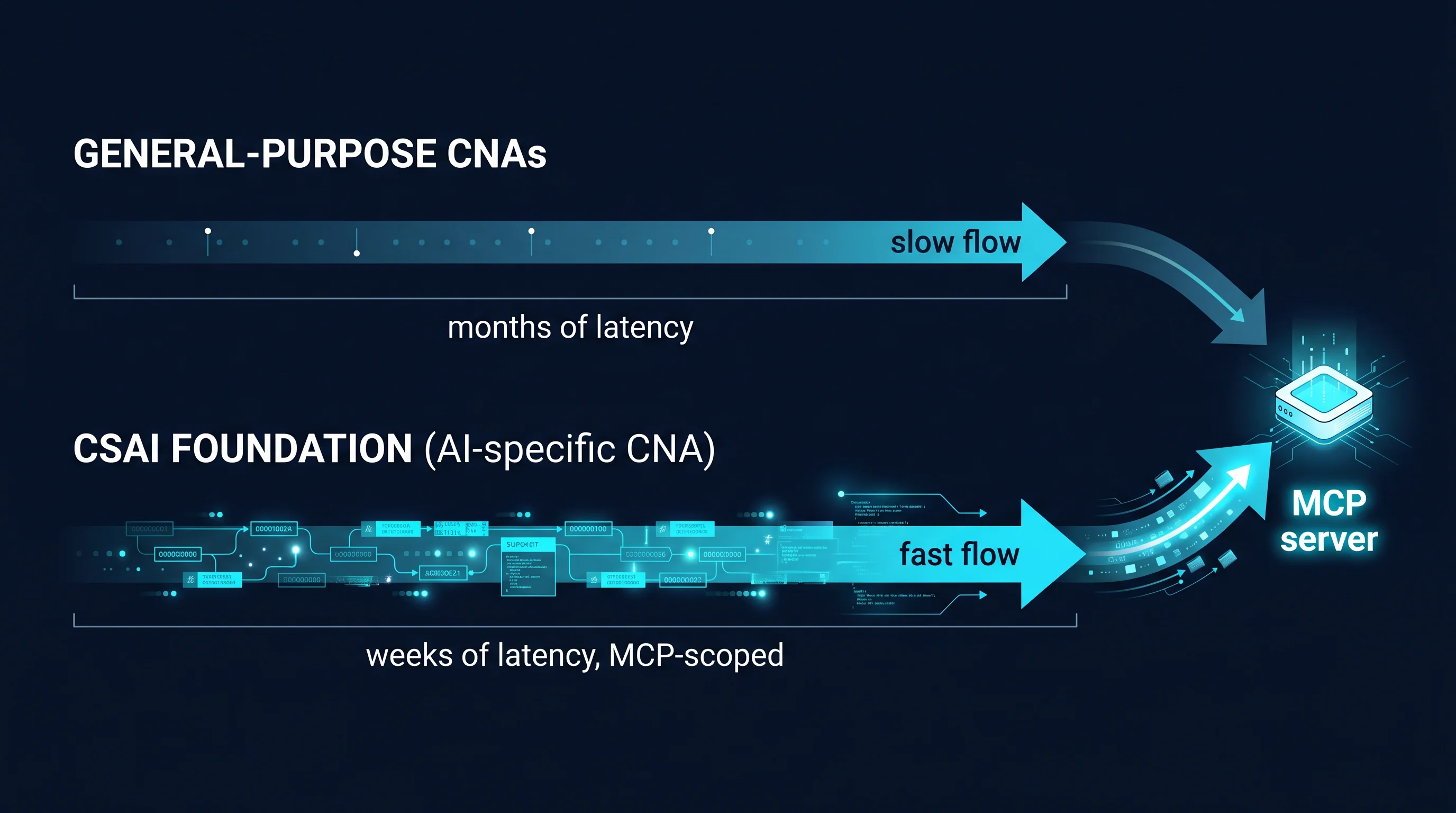
MCP has been moving faster. Q1 2026 alone produced approximately thirty MCP-related CVEs, most of them through general-purpose CNAs reacting to disclosed issues rather than discovering them. The OX Security STDIO research that produced ten of those CVEs ran from November 2025 through April 2026 — six months of methodical work by four researchers — before the issues were assigned identifiers. The latency is not unusual for general-purpose CNAs. It is the cost of generality.
A dedicated AI CNA is built differently. Its researchers monitor MCP-specific behavior. Its disclosure process is calibrated to AI-specific assumptions about how agents interact with tools. Its scope statement does not have to compete with operating system vulnerabilities, browser bugs, or kernel races for prioritization. The same vulnerability that took six months to surface through OX Security and a general-purpose CNA path could surface through CSAI in weeks, because CSAI does nothing else.
The implication for enterprises is not subtle. The MCP CVE feed is about to get faster. The number of identifiers issued per quarter will rise. Each new identifier potentially affects servers that have already been admitted into production environments. The question for every governance team is whether they can match an incoming CVE against their existing fleet of admitted servers — and whether that match can be performed quickly enough to act on before the vulnerability is exploited.
The Re-Review Window
The window between a vulnerability disclosure and an enterprise’s response to it is the window during which the enterprise is operating with known-vulnerable infrastructure. In traditional vulnerability management, this window is bounded by the patching cycle: the time between the patch’s release and its deployment across the environment.
For MCP servers, the equivalent window has a different shape. There is no central package manager pushing updates. There is no automatic patching infrastructure. The server in production may continue running the same version that was admitted weeks or months ago, and the operator of the server may have shipped a fix without the consumer noticing. The window between a CSAI CVE for an MCP server and the consumer’s response is bounded by two things: when the consumer learns about the CVE, and when the consumer can identify which of their admitted servers are affected.
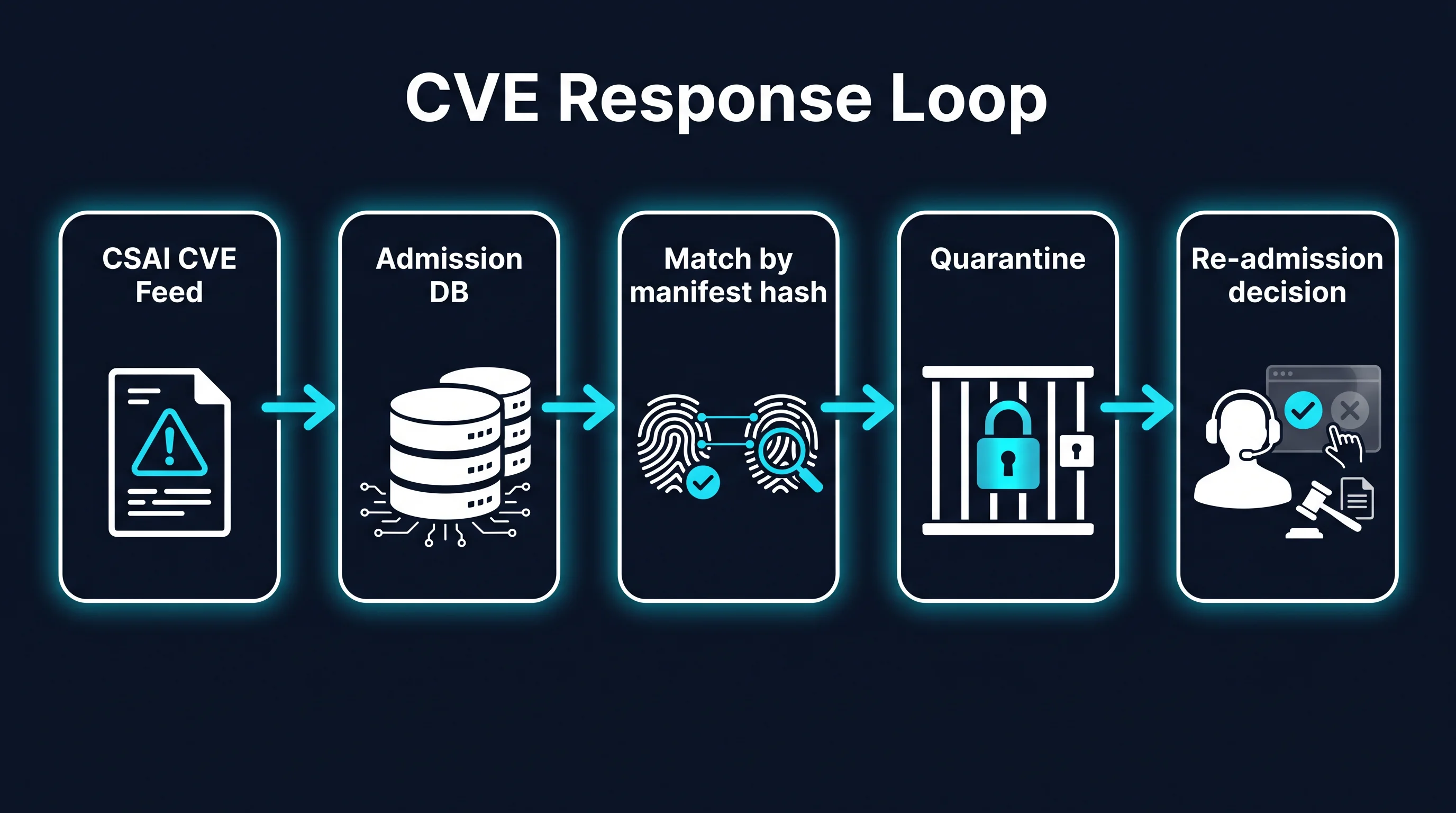
The admission record is the artifact that bounds the second part. Without an admission record, the consumer’s options are narrow: enumerate every server they think they have running, check each one against the CVE description, and hope the enumeration is complete. With an admission record, the workflow is mechanical. The CSAI CVE describes the affected server and version. The admission database has the manifest hash and identity of every admitted server. The intersection is a query.
The same record supports the inverse direction. When CSAI issues a CVE for a server that the enterprise has not admitted, the admission database confirms the absence. This is the negative finding that is hard to produce by any other means. “We are not affected because we never admitted that server” is a defensible posture only if the admission database is authoritative.
The admission timestamp turns into the lifecycle anchor. From the moment of admission to the moment of CVE disclosure is the period during which the server was operating in production without the CVE being known. From CVE disclosure to re-admission (or revocation) is the period during which the server was known-vulnerable. Both periods are measurable, and both are required by audit frameworks that require evidence of timely vulnerability response.
Quarantine as the Re-Admission Mechanism
The architectural choice that makes admission records useful for CVE response is quarantine-by-default. A server in production has been admitted. A CVE drops. The admission state of the server changes — it is no longer a server with a clean review; it is a server with an outstanding review item. The proxy can move the server back into quarantine without disrupting the rest of the environment.
Quarantine is not the same as revocation. A revoked server is gone from the environment. A quarantined server is still tracked, still inventoried, still part of the admission database, but its connections are gated until a new admission decision is made. Re-admission is the opportunity to incorporate the CVE context into the decision. The reviewer sees the original admission record, the CSAI CVE, the upstream patch (if available), and decides whether to re-admit, re-admit with constraints, or revoke.
This workflow is the operational pattern that the CSAI CNA assumes. The CNA’s job is to produce the identifier and the description. The enterprise’s job is to act on the identifier. The action requires a substrate that can match the identifier against the affected production state. Without that substrate, the CNA’s output lands in the inbox of someone who has to do the matching by hand, which is not a workflow that scales as the CVE feed accelerates.
Convergence with Article 12
The CSAI rollout schedule and the EU AI Act Article 12 enforcement schedule are nearly the same schedule. CSAI’s four-phase rollout begins June 2026 and runs through December 2027. Article 12 enforcement begins August 2, 2026, with high-risk AI system requirements active from that date. The CSAI rollout is calibrated to align with Article 12’s NIST AI RMF and ISO/IEC 42001 references — both of which are part of the regulatory framework the EU AI Act imports.
For an enterprise, this convergence means that the same admission record that supports CSAI CVE response is also the record that supports Article 12 logging requirements. Article 12 requires automatic, lifetime logging. CSAI requires the ability to identify affected servers when an identifier is issued. Both requirements are satisfied by the same artifact: a per-server admission record that is created at admission, retained for the lifetime of the deployment, and queryable by identifier or affected component.
This is the part of the regulatory environment that does not get enough attention in MCP discussions. The compliance frameworks and the vulnerability frameworks are converging on the same data structure. An enterprise that has the data structure can satisfy multiple frameworks from the same source. An enterprise that does not has to assemble the data structure separately for each framework, with different completeness assumptions and different retention policies for each. The latter is more expensive and more error-prone.
What Compliance Teams Should Be Doing in May 2026
Three operational changes are reasonable to make ahead of the CSAI feed going live.
The first is establishing the admission record as the source of truth for “what MCP servers are running.” This sounds tautological, but it is not. Many enterprises have multiple partial inventories — one in their security ticket system, one in a developer wiki, one in a deployment configuration file — and none of them is complete. Picking one and committing to it as the canonical record is a precondition for matching CVE identifiers against the fleet.
The second is wiring the CSAI feed into the matching infrastructure. CVE feeds have been a solved problem for two decades; the standard tooling consumes NVD JSON, applies a matching ruleset, and produces a list of affected assets. The same tooling generalizes to a CSAI feed. The work is in the matching ruleset, which has to know how to compare a CSAI advisory’s affected-component description against the manifest hashes and tool declarations in the admission database.
The third is documenting the re-review SLA. CSAI’s CNA authority will produce identifiers faster than the general-purpose CNAs. The enterprise’s response time has to be calibrated to the new feed’s cadence. A 30-day re-review window that worked for the slow general-purpose feed is unlikely to work for a fast AI-specific feed. The new SLA depends on how aggressive the enterprise wants to be, but it should be deliberately chosen rather than inherited from the previous regime.
The Re-Review Loop Is the Compliance Loop
The pattern that emerges across the CSAI announcement, the existing MCP CVE rate, and the Article 12 timeline is a single loop. Servers are admitted into the environment with a structured record. CVEs are issued by a fast, dedicated CNA. The records are matched against the CVEs. Affected servers are quarantined and re-reviewed. The re-admission decision incorporates the new information. The loop runs continuously.
This is the operational shape that vulnerability management has had for traditional software for thirty years. MCP did not have the loop because it did not have the admission record. CSAI’s CNA authority is the missing piece on the disclosure side. The admission record is the missing piece on the response side. With both in place, the loop closes, and MCP vulnerability management starts to look like vulnerability management for everything else in the production environment — measurable, auditable, and bounded in time.
CSAI just made the disclosure side fast. Whether the response side keeps up is a question of what records are in place when the first CSAI CVE for a server in your environment lands in the queue.